The world of numerical probability and chance has fascinated humanity for centuries. Among the myriad of games that have captured the attention of enthusiasts, the dhanlaxmi satta game stands out as a prominent fixture in the modern landscape of localized lotteries and number games. While many view these games purely as a roll of the dice, seasoned participants understand that navigating this space requires a blend of historical knowledge, mathematical comprehension, and strict risk management. The Interesting Info about jago89 slot.
Whether you are a curious observer trying to decode the cultural phenomenon or an analytical mind looking to understand the mechanics behind the numbers, this comprehensive guide will break down the intricacies of the system. We will explore the deep-rooted history, the mathematical principles governing the draws, and the modern-day realities of participating in these markets.
Chapter 1: The Historical Roots of the Game
To truly understand the modern dhanlaxmi satta game, one must first look back at how these numerical markets originated. The game we see today is a highly digitized, streamlined evolution of practices that began decades ago in the bustling financial hubs of India.
The Origin of Textile Mill Betting
The genesis of this numerical phenomenon can be traced back to the bustling cotton mills of Mumbai (then Bombay) in the mid-20th century. The origin of textile mill betting is a fascinating tale of financial speculation bleeding into everyday street culture. In the 1950s, mill workers and local traders began placing wagers on the opening and closing rates of cotton transmitted from the New York Cotton Exchange to the Bombay Cotton Exchange via teleprinters.
People would guess the final digits of these daily rates. It was a simple system of chance, but it captured the imagination of the working class, providing a daily thrill and the potential for a small financial windfall.
The Transition to the Matka System
When the New York Cotton Exchange ceased operations in 1961 due to global regulatory changes, the bustling betting market in Bombay suddenly lost its data source. However, the appetite for the game remained. This led to the creation of the “Matka” system.
The history of matka king ratan khatri is central to this era. Khatri, along with another pioneer named Kalyanji Bhagat, revolutionized the game by replacing the cotton rates with a new system. They would write the numbers 0 to 9 on pieces of paper, place them in a large earthen pot (a matka), and draw them out to announce the winning numbers. Khatri’s syndicate was particularly famous for its vast reach and reliability, earning him the moniker of “Matka King.” His system formalized the drawing times, the payouts, and the complex networks of bookies (khaiwals) that still echo in today’s digital variants.
Today, games like the dhanlaxmi satta game operate on the foundational principles laid down during Khatri’s era, albeit replacing the physical earthen pot with sophisticated digital algorithms and random number generators.
Chapter 2: Decoding the Vocabulary
Before diving into strategies and probabilities, you must speak the language of the market. The ecosystem is filled with unique slang and technical terms that can be bewildering to the uninitiated. Here are some common matka terminologies explained to help you navigate the landscape.
Essential Terminology
- Matka: Originally the earthen pot used to draw numbers, now a catch-all term for the game itself.
- Single: Any single digit between 0 and 9.
- Open and Close: The game is usually played in two parts. The “Open” result is declared first, followed by the “Close” result a few hours later.
- Bazi: A term synonymous with a round of the game or a specific bet.
- Khaiwal: The middleman or bookie who collects the wagers and distributes the winnings.
The Difference Between Jodi and Panna
Understanding the difference between jodi and panna is arguably the most crucial step for anyone learning the game’s mechanics.
- Panna (or Panel): A Panna is a three-digit number drawn at the start of the game. For example, the drawn numbers might be 1, 4, and 7. The Panna is written in ascending order: 147.
- Single Digit Generation: To get the final “Single” digit from the Panna, you add the three numbers together. In the case of 147: 1 + 4 + 7 = 12. The last digit of the sum is 2. Therefore, the single digit derived from the Panna 147 is 2.
- Jodi: A Jodi (meaning “pair” in Hindi) is formed by combining the single digit from the Open draw and the single digit from the Close draw. If the Open single is 2, and the Close single (derived from a second Panna, say 348 -> 15 -> 5) is 5, the resulting Jodi is 25.
Players can place wagers on the Open Single, the Close Single, the specific Panna, or the combined Jodi.
Chapter 3: Mechanics and Reading the Data
For those looking for a beginners guide to number guessing, the first lesson is that “guessing” is a misnomer. Experienced players do not randomly pick numbers; they analyze historical data and apply specific methodologies to make educated selections.
How to Read Panel Charts
At the heart of any analytical strategy is the panel chart. If you want to understand the rhythm of the dhanlaxmi satta game, you must learn how to read panel charts.
A panel chart is a comprehensive grid displaying the historical records of the game over weeks, months, or even years.
- Rows and Columns: The chart is typically organized with the days of the week running horizontally across the top, and the weeks running vertically down the side.
- The Cell Structure: Inside each cell of the grid, you will usually see a format that looks like this: 147 – 25 – 348.
- 147 is the Open Panna.
- 2 is the Open Single.
- 5 is the Close Single.
- 25 is the Jodi.
- 348 is the Close Panna.
By studying these charts, analysts look for patterns. For instance, they might track how many times a specific Jodi has appeared in the last 30 days, or look for “cut numbers” (numbers that, in theory, cancel each other out based on the game’s internal logic).
Analyzing Satta Results
When checking satta results, timing and accuracy are paramount. The results are published at exact, pre-determined times. For the dhanlaxmi satta game, there is a specific window for the Open and Close declarations. Analyzing these results immediately helps players verify their strategies and adjust their data charts for the next day’s calculations.
Chapter 4: The Mathematics of Chance
Relying entirely on gut feeling is a fast track to disappointment. The most successful participants approach the game not as a mystical event, but as an exercise in probability.
Calculating Probability in Lottery Games
To make informed decisions, one must master the art of calculating probability in lottery games. Let’s break down the mathematical realities of the game:
- Single Digit Probability: There are 10 possible single digits (0 through 9). The probability of correctly guessing a single digit is exactly 1 in 10, or 10%.
- Jodi Probability: A Jodi is a two-digit number ranging from 00 to 99. There are 100 possible combinations. Therefore, the probability of correctly guessing a Jodi is 1 in 100, or 1%.
- Panna Probability: Because Pannas are drawn in a specific way (usually in ascending order, with some restrictions on repeated digits depending on the variation of the game, such as Single Patti, Double Patti, or Triple Patti), there are exactly 220 valid Panna combinations. The probability of hitting a specific Panna is 1 in 220.
Understanding these baseline mathematical facts is crucial. The higher the payout, the lower the mathematical probability of that event occurring.
Mathematical Patterns in Matka Systems
Many players swear by specific mathematical patterns in matka systems. While the draw is inherently random, the human mind excels at finding sequences in chaos. Some popular strategic concepts include:
- Line Tracking: Following a specific vertical line (e.g., all Tuesdays) on the panel chart to find recurring sums.
- The Rule of Averages: If a particular number hasn’t appeared in an unusually long time (a “cold” number), some players assume it is mathematically “due” to appear to balance the distribution. (Note: In pure mathematics, this is known as the Gambler’s Fallacy, as each draw is an independent event. However, it remains a popular strategy).
- Cut Numbers: In this system, numbers are paired with their “cut” or opposite (e.g., 1 and 6, 2 and 7, 3 and 8, 4 and 9, 5 and 0). If a 2 appears in the Open, a strategist might favor a 7 in the Close based on historical chart tendencies.
Practical Satta Tips
If you are engaging with the game, here are some pragmatic satta tips:
- Focus on Singles: While Jodis and Pannas offer higher payouts, Singles have the highest statistical probability of success. Consistency is mathematically more viable here.
- Maintain a Data Log: Do not rely on memory. Use spreadsheets to meticulously track the panel charts.
- Avoid Chasing Losses: Statistically, trying to recoup a loss by doubling your next wager (the Martingale strategy) in a game with a high house edge or high volatility usually leads to bankroll depletion.
Chapter 5: Navigating the Digital Ecosystem
The transition from physical khawials to the internet has fundamentally changed the landscape. Today, players interact with websites and mobile applications. While this offers convenience, it also opens the door to significant digital risks.
How to Track Daily Results Safely
In the digital age, speed is everything. However, speed should not compromise security. Safely tracking daily results requires vigilance.
- Use Established Portals: Stick to well-known, high-traffic websites with a track record of accurate reporting.
- Cross-Verification: Never rely on a single source. Cross-reference the results across three or four different platforms. If there is a discrepancy, wait for the consensus to settle.
- Avoid Downloading Unnecessary Apps: Many websites force users to download third-party APK files to view results. These can be riddled with malware. Safe result tracking can almost always be done directly through a secure web browser.
Identifying Fraudulent Gambling Websites
The internet is rife with bad actors looking to exploit eager players. Identifying fraudulent gambling websites is a vital skill. Look out for these massive red flags:
- Guaranteed Leaks: Any website claiming to have “100% confirmed VIP leaked numbers” directly from the game organizers is a scam. The draws are random, and anyone asking for upfront payment for guaranteed numbers is executing an advance-fee fraud.
- No SSL Certificate: If the website URL begins with HTTP instead of HTTPS, and lacks the padlock icon in the browser bar, your connection is not secure. Any data you enter can be intercepted.
- Unrealistic Payout Ratios: If a site promises payouts that significantly exceed the mathematical norms of the game (e.g., offering 150x return on a Jodi when the standard is 90x), it is likely a trap designed to collect deposits and never pay out.
- Poor User Interface and Spelling Errors: Legitimate platforms, even in this gray market, usually invest in decent web infrastructure. Sites riddled with broken links and terrible grammar are often quickly assembled scam pages.
Chapter 6: The Legal Framework and Alternatives
One cannot discuss the dhanlaxmi satta game without addressing the elephant in the room: the law. The legal framework surrounding games of chance in India is complex, outdated, and heavily fragmented.
Is Online Betting Legal in India?
The short answer to the question “is online betting legal in india?” is: It depends on where you are and what you are doing.
Gambling in India is primarily governed by the Public Gambling Act of 1867. Because this law predates the internet by over a century, it creates a massive gray area. Furthermore, under the Indian Constitution, gambling and betting are State subjects. This means each state has the right to formulate its own laws regarding gambling activities.
- Games of Skill vs. Games of Chance: The Supreme Court of India has historically distinguished between games of skill (like rummy or fantasy sports, which are largely legal) and games of chance. The Matka system, despite the mathematical tracking players use, is legally classified as a game of chance.
- State Variations: States like Goa, Sikkim, and Meghalaya have legalized and regulated certain forms of casino gaming and lotteries. Conversely, states like Telangana, Andhra Pradesh, and Tamil Nadu have passed stringent laws explicitly banning online real-money gaming, including games of chance.
Legal Consequences of Unregulated Betting
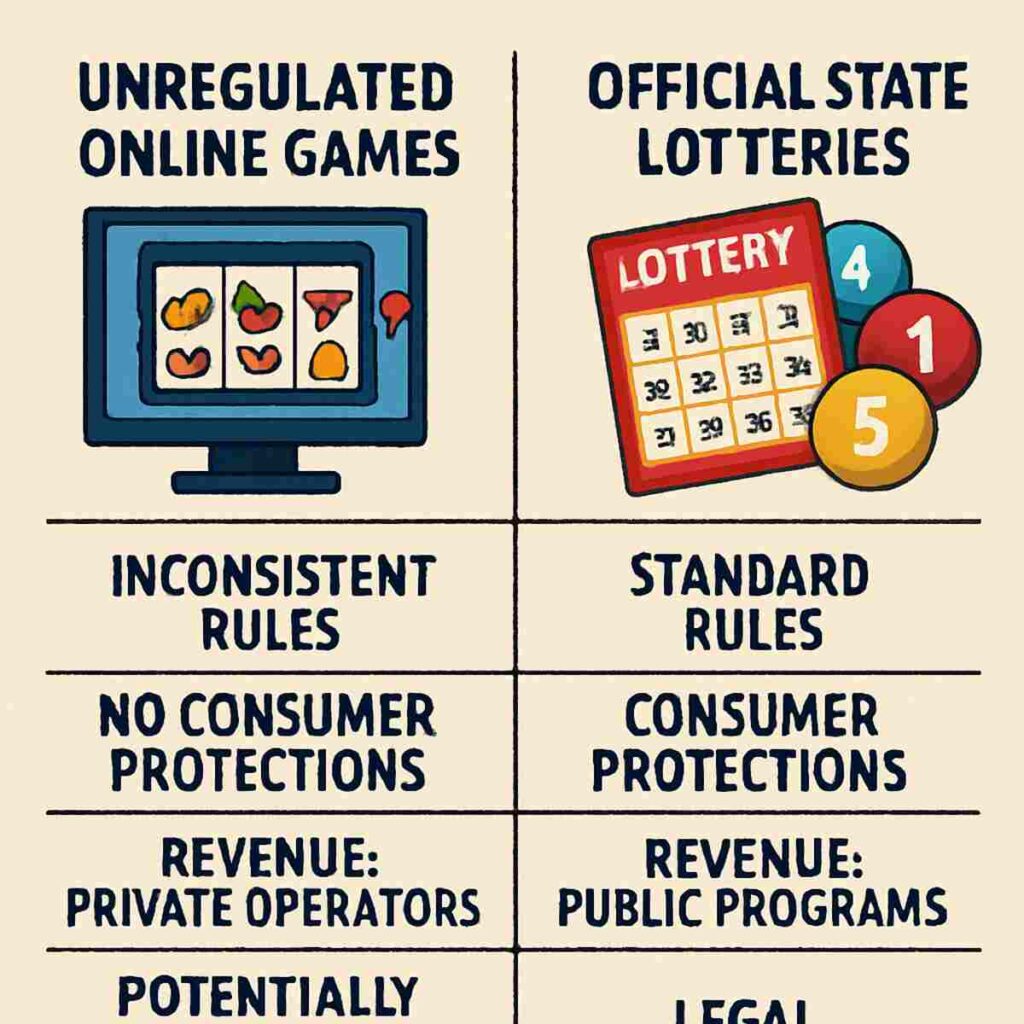
Engaging in unregulated platforms carries significant risk. The legal consequences of unregulated betting can be severe. If caught participating in illegal street betting, individuals can face fines and potential imprisonment under state-specific gambling acts. Furthermore, because these unregulated digital platforms operate outside the purview of the Reserve Bank of India (RBI) and the legal system, if a platform steals your money or refuses to pay out your winnings, you have absolutely zero legal recourse. You cannot go to the police to report that an illegal gambling site stole your funds without implicating yourself.
Official State Lottery Alternatives
For those who enjoy the thrill of the draw but want to stay strictly within the law, exploring official state lottery alternatives is the best path forward.
Several Indian states officially run and heavily regulate their own lottery systems. The most prominent examples include:
- Kerala State Lotteries: The pioneer of government-run lotteries in India, offering daily draws and massive bumper prizes during festivals like Onam.
- Sikkim State Lotteries: Known for its highly regulated daily draws.
- Nagaland and West Bengal: Both states offer legal, government-backed paper lotteries.
Participating in these state-run lotteries ensures that your money is handled securely, the draws are audited for fairness, and any winnings are paid out legally with the appropriate taxes deducted.
Chapter 7: Mitigating Risks and Responsible Play
Whether you are studying the probability charts purely for academic interest or looking to transition to legal state lotteries, understanding the psychological and financial dangers of number games is crucial.
Understanding Matka Gambling Risks
The thrill of predicting the correct Jodi can quickly turn into a nightmare if not managed properly. Understanding matka gambling risks is the first step toward self-preservation.
- The House Edge: Mathematically, the game is always designed to favor the operator. Over a long enough timeline, the house always wins.
- Chasing Losses: The psychological urge to “win back” lost money is the leading cause of financial ruin in games of chance. This often leads to larger, more reckless wagers.
- Financial Opacity: In unregulated markets, players often resort to borrowing money from loan sharks or using credit to fund their wagers, leading to catastrophic debt spirals.
Responsible Gaming Practices for Beginners
If you are engaging in any form of probability-based gaming, strictly adhering to responsible gaming practices as a beginner is non-negotiable.
- Establish a Strict Bankroll: Before you even look at a panel chart, determine exactly how much disposable income you are willing to lose. This money should be purely for entertainment, separate from rent, groceries, and savings. Once this bankroll is gone, you stop.
- Set Time Limits: It is easy to spend hours analyzing historical data and tracking daily results. Set a timer. When the timer goes off, step away from the screen.
- Understand the Gambler’s Fallacy: Remind yourself constantly that past performance does not guarantee future results. Just because the number 7 hasn’t appeared in three weeks does not mean it has a greater chance of appearing tomorrow.
- Do Not Play Under the Influence: Never engage with real-money games when stressed, depressed, or under the influence of alcohol. Emotional decision-making destroys strategic bankroll management.
- Recognize the Signs of Addiction: If you find yourself hiding your participation from family, thinking about the game constantly, or feeling irritable when you cannot check the results, you may be developing a gambling problem. Seek help immediately through professional counseling or helplines.
Conclusion
The dhanlaxmi satta game, much like its historical predecessors, is a complex intersection of culture, mathematics, and human psychology. From the early days of textile mill betting to the sophisticated digital networks of today, the allure of predicting the unpredictable remains a powerful force.
However, success—or at least, survival—in this space requires far more than blind luck. It demands a rigorous understanding of the difference between jodi and panna, a dedication to learning to read panel charts, and the cold, rational application of probability calculations in lottery games.
More importantly, it requires a clear-eyed view of market realities. From identifying fraudulent gambling websites to acknowledging the severe legal consequences of unregulated betting, protecting yourself legally and financially must always take precedence over the thrill of the draw.
By applying strict responsible-gaming practices for beginners, viewing the game through a mathematical lens, and considering official state lottery alternatives where appropriate, you can navigate the fascinating world of probability safely, responsibly, and intelligently. Remember, the true master of the game is not the one who wins the biggest payout, but the one who knows exactly when to walk away.