You cannot smell, hear, or see electricity until it is already making a destructive move. Unlike a roaring fire or a spinning saw blade, the power running through your home waits in complete silence behind drywall and plastic switch plates. This invisible nature is exactly why treating every wire with deep respect is your only true line of defense against a life-altering shock. Before any electrical technician touches a terminal, they understand that safety is never just a quick checklist, but a constant, protective mindset. Select the best electrical panel upgrade Highlands Ranch.
Many weekend warriors fall into the trap of thinking standard household power is relatively harmless. According to the Occupational Safety and Health Administration (OSHA), everyday 120-volt residential wiring actually accounts for a massive portion of fatal electrical accidents. People often assume “low voltage” means low danger, but it takes less than a single Amp—a basic measure of electrical current flow—to stop a human heart. That standard wall outlet pushing power to your television packs more than enough invisible energy to cause severe harm if your body becomes the path to the ground.
Overcoming this false sense of security requires adopting the exact same rule the professionals use: always treat every wire as if it is completely live. You might have flipped the breaker switch to the “Off” position, but the wires packed tightly inside that junction box could still be carrying a lethal charge from another shared circuit. Assuming the power is dead without verifying it with a proper tester is the fastest way to turn a routine weekend project into a dangerous close call. A successful day of work is built on being methodically cautious and systematically aware, rather than simply being afraid of the wires.
Building a reliable pre-work mental checklist bridges the gap between hoping you are safe and knowing you are protected. Before picking up a single tool, pause and ask yourself if you dropped your screwdriver right now, would it bounce off a dry floor or strike a live, bare wire? This kind of situational awareness is a foundational requirement for anyone stepping into a professional electrical job, but it is just as crucial for a homeowner changing a simple light switch. Taking ten seconds to survey your environment for stray water, metal ladders, or floor clutter can completely eliminate a disaster before it ever starts.
Mastering these foundational safety tips ultimately gives you the confidence to approach repairs with a clear, focused head. We want to aim for zero accidents through smart, repeatable habits rather than relying on pure luck or rubber-soled sneakers to save the day. By replacing blind overconfidence with absolute certainty, you ensure that every upgrade, repair, or inspection ends safely with the lights coming back on exactly as planned.
Treat Every Wire as ‘Hot’: The Professional Habit That Saves Lives
Flipping a wall switch to “off” plunges your room into darkness, but it rarely guarantees the wires inside the box are safe to handle. One of the most common causes of electrical shocks on job sites happens when people assume a dark lightbulb means a dead circuit. Inside the wall, you usually encounter a “switch-leg” wire (which loses power at the switch) sitting beside a “constant-hot” wire (carrying live energy directly from your breaker panel 24/7). Even in fundamental electrician training, professionals learn quickly that trusting a plastic wall switch is a dangerous gamble.
Invisible energy can still lurk in the wall long after you cut the main power. We call this “phantom voltage,” which acts like a static electrical echo building up in dead wires sitting too close to live ones. To walk away safely from any routine electrical job, you must adopt the “Double Check” protocol. This means flipping your breaker, then using a handheld voltage tester—a pen-like tool that beeps near active current—to physically check every single wire before your skin touches anything.
Safety Alert: Always treat every wire as actively live until your tester proves otherwise. While testing is your best defense, accidents happen if a tool slips or your hand accidentally brushes exposed copper. Your body still needs a physical barrier to stop stray current from traveling through you into the ground. That is precisely why we must evaluate your wearable gear, and why your comfortable everyday sneakers aren’t enough to protect you.
The PPE Essentials: Why Sneakers Aren’t Enough to Protect You
Most people tackle weekend projects in their favorite athletic wear, completely unaware of the hidden danger. When performing a routine risk assessment for electrical installations, the first thing to check isn’t your toolbag—it is your clothing. Synthetic fabrics like polyester or nylon have dangerously low melting points. If a sudden spark occurs while you are wiring an outlet, those materials can instantly melt right into your skin. Always swap the gym shirt for 100% heavy cotton or denim, which acts as a natural shield that will not fuse to your body under extreme heat.
Creating a physical barrier against stray voltage requires specialized gear. Proper personal protective equipment for electrical work is designed to break the circuit before it enters your body. Before touching a breaker panel, verify you have these three essentials:
- EH-Rated Boots: Standard rubber-soled sneakers are far too thin to block a shock. Look for the “EH” (Electrical Hazard) tag on heavy work boots, meaning the thick soles are specifically tested to resist electricity.
- Insulated Gloves: A leather work glove prevents cuts, but you need rubber-insulating gloves worn underneath to actively block current from entering your hands.
- Z87+ Safety Glasses: Everyday reading glasses will not stop the blinding light and flying melted copper of a sudden spark; always wear wrap-around, impact-rated eye protection.
Even with EH-rated boots and heavy cotton, your wearable gear only shields you from what you directly touch. Sometimes, the danger does not wait for your hands to make contact. Under the right conditions, power can launch itself right through the air, demanding serious respect for airborne hazards.
Understanding Arc Flash: How Electricity Can Jump Like Lightning
You might think electricity always stays neatly inside its wires until you physically touch it. However, a loose connection or a slipped tool can cause electricity to leap through the air in an event called an arc flash. Think of this as a localized bolt of lightning trapped inside your electrical panel. This sudden burst generates heat hotter than the surface of the sun in a fraction of a second, making preventing arc flash and blast injuries just as critical as avoiding a direct shock.
Because this invisible danger travels through the air, staying safe means recognizing the invisible safety line drawn around a live panel. Professional best practices, like the NFPA 70E electrical safety requirements, refer to this safe distance as an “approach boundary.” For a homeowner working near an open breaker box, this simply means keeping your face and torso leaning well back from exposed wires. If an arc blast—the explosive, deafening pressure wave that follows the flash—occurs, that physical distance provides the crucial buffer needed to avoid severe burns.
An electrical jump rarely happens on its own; it is usually triggered when a piece of metal accidentally bridges a gap between two live circuits. If a standard wrench slips from your grip and hits the wrong spot, it becomes the perfect pathway for that miniature lightning strike to ignite. To stop this dangerous chain reaction before it starts, the equipment in your hands must be just as shielded as your body.
Insulated vs. Non-Insulated Tools: Why Your Screwdriver Needs a Suit of Armor
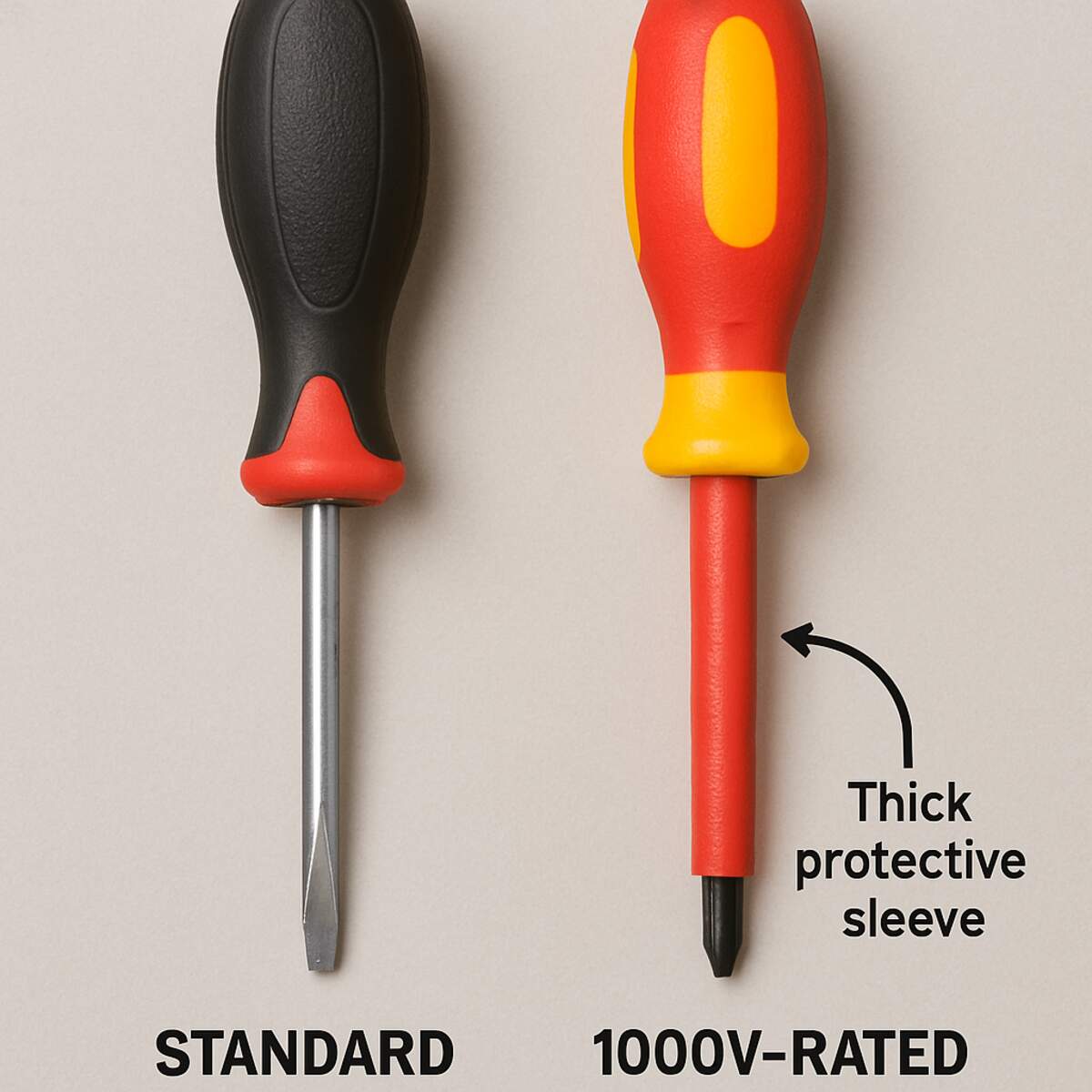
Many DIYers grab their favorite rubber-handled screwdriver, assuming that squishy grip will naturally block electricity. In reality, standard handles merely provide comfort and will not stop a dangerous shock. When an electrical technician works near power, they understand the life-saving difference between insulated vs non-insulated hand tools. A true insulated tool wears a literal suit of armor, featuring a strict 1000V rating—meaning it is tested to block up to 1,000 volts—and a thick protective sleeve running all the way down the metal shaft, known as shank insulation.
Owning the right gear only protects you if it remains in flawless condition. Before reaching into any wall box, inspect that protective coating closely for cracks, gouges, or peeling. Even a microscopic pinhole in the shank insulation creates a fast lane for electricity to travel straight into your fingers. Furthermore, mastering the proper grip prevents disasters. You must always keep your hand securely behind the flared guard at the base of the handle, never letting your fingers creep down toward the metal, ensuring an accidental slip does not bridge the gap to a live component.
Armor provides an excellent safety net, but the best way to avoid a shock is confirming the circuit is completely dead before your screwdriver ever touches a screw. You might have flipped the breaker, but relying on handwritten panel labels alone is a dangerous gamble. To guarantee your workspace is truly safe, you must physically verify the absence of invisible energy.
The Non-Contact Voltage Tester: How to Prove the Power is Actually Off
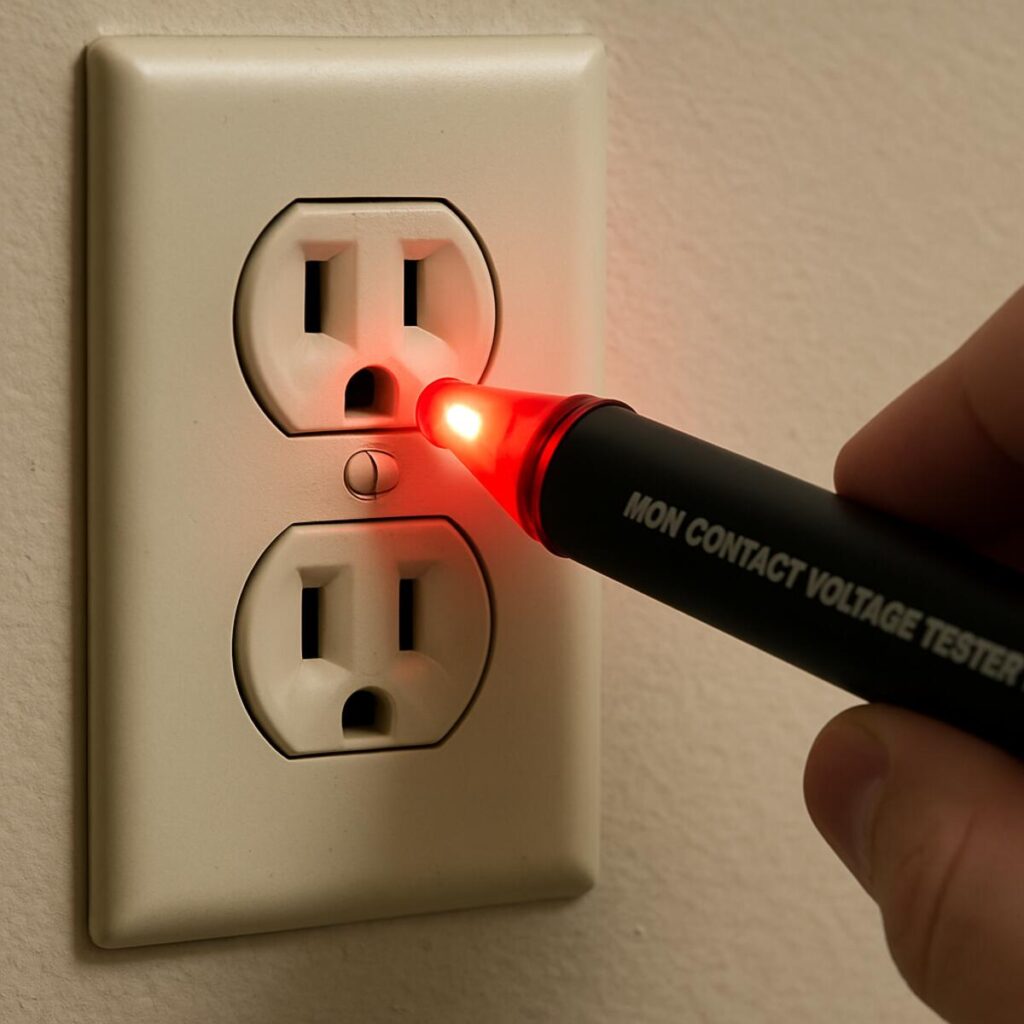
Your eyes cannot see electricity, but a non-contact voltage tester acts as your early warning system. Before touching a single wire, mastering how to use a non-contact voltage tester safely is the most critical lesson in basic electrician training. These pen-shaped tools beep or flash when placed near an energized cord, but you must know exactly where to probe. On a standard wall outlet, the shorter slot is the “hot” side where power actually lives, making it the perfect testing zone to confirm your device is functioning properly.
Professionals never trust their equipment blindly, which is why they rely on the foolproof “Live-Dead-Live” method. First, check your tester against a known live outlet to ensure the batteries work and the sensor is active. Next, go to the circuit you just turned off at the breaker and probe it to confirm it is completely dead. Finally, return to the original live outlet and test it one last time; this guarantees your tool did not unexpectedly fail between steps, keeping you perfectly safe.
Even the most reliable testers have quirks you must understand, particularly a tricky phenomenon called capacitive coupling. Think of this as “ghost voltage”—when a dead wire runs alongside a live wire inside your walls, it can absorb invisible phantom energy, causing your tester to beep even when the breaker is off. If your tool flashes but you know the switch is flipped, pause and evaluate the surrounding wires. Once you confidently confirm the power is truly gone, your next job is making sure nobody accidentally turns it back on.
Lockout Tagout (LOTO) for Homeowners: Locking the Door on Electrical Accidents
Imagine you are wiring a ceiling fan, and someone suddenly flips the breaker back on to fix the Wi-Fi. This terrifying scenario is exactly why professionals rely on lockout tagout procedures for electricians. In industrial settings, workers use heavy padlocks to secure energy sources. At home, your goal is achieving “exclusive control”—meaning absolutely no one but you has the physical ability or permission to restore the electricity.
You don’t need expensive padlock gear to secure a standard residential panel. Just follow these five steps to create a safe home lockout system:
- Identify the correct breaker and switch it to the off position.
- Verify the circuit is entirely dead using your voltage tester.
- Place brightly colored painter’s tape completely across the flipped breaker switch.
- Stick a bold warning note directly over the panel cover.
- Tell everyone in the house that the electrical box is strictly off-limits until you say otherwise.
Securing the panel physically handles the “lock,” but the “tag” relies on loud, clear communication with your household. Maintaining this firm boundary around the energy source ranks among the most vital safety tips anyone can practice. With your power safely restricted and your family warned, your wires are secure. Yet, before picking up a single screwdriver, you must also evaluate the physical ground beneath your feet.
Moisture and Conductivity: Why a Wet Floor Changes Everything
You might know water and electricity are a disastrous combination, but the real danger lies in how moisture interacts with your body. Human skin naturally has electrical resistance, which acts as a physical barrier slowing down current. However, that protective barrier vanishes the moment your hands get sweaty or you step onto a damp basement floor. This is exactly why moisture increases electrical conductivity risks so dramatically; water turns your skin from a tough wall into an open highway for electricity.
Because of this heightened danger, rooms like kitchens and bathrooms are high-risk zones requiring special equipment. If you are replacing an outlet near a sink or outdoor patio, you will encounter a GFCI (Ground Fault Circuit Interrupter). Think of a GFCI as a highly sensitive lifeguard for your wiring; it is a specialized outlet that shuts off power instantly if it detects electricity leaking toward water. The lifesaving benefits of ground fault circuit interrupters ensure that if current strays, the power stops before shocking you.
Keeping your workspace perfectly dry remains just as important as turning off the breaker. Wipe up any puddles around your ladder and dry your sweating hands thoroughly before touching any wires. Even when your environment is completely dry, electricity can still behave unpredictably if a loose connection touches a metal electrical box. To handle those rogue sparks safely, your house relies on another built-in safety net designed to channel errant electricity away from you.
The Grounding Emergency Exit: How Ground Wires Save You from Stray Current
Every normal circuit uses a hot wire to deliver power and a neutral wire to return it. But what happens if a wire comes loose and energizes the metal casing of your washing machine? This is where the Equipment Grounding Conductor (EGC)—usually a bare copper or green wire—steps in. Think of the neutral wire as the daily commuter train and the EGC as an emergency exit. It waits silently to give stray voltage a safe, instant path to the earth rather than through your body.
Connecting all household metal components to share this emergency exit is a process called bonding. When a professional electrical technician wires a house, they tie every metal switch box and appliance frame to this safety network. Utilizing proper grounding and bonding techniques guarantees that if a live wire accidentally touches metal, electricity rushes down this dedicated fault path. This sudden, massive surge immediately trips the breaker, shutting off the dangerous power before a shock can even occur.
Missing safety networks often reveal themselves through older two-prong wall outlets or a faint, vibrating tingle when you touch a metal appliance. Those subtle warning signs mean your emergency escape route is broken, leaving you completely unprotected from stray current. Because hidden electrical dangers can lurk behind any wall or inside any loose junction box, a simple room scan is essential to spot them early.
Performing a 2-Minute Risk Assessment: Mapping the Hazards Before You Start
You might have the power turned off, but tunnel vision remains a DIYer’s worst enemy. Before unscrewing a wall plate, scanning your surroundings is one of the most vital safety protocols you can adopt. Professionals never just dive into a repair; they perform a deliberate room scan to spot hidden traps. This situational awareness ensures a basic outlet swap doesn’t turn into an unexpected injury just because you tripped over a stray shoe.
Conducting a risk assessment for electrical installations takes less than two minutes using this 5-point job-site walkthrough checklist:
- Clear the clutter: Remove tripping hazards like rugs or tools from your immediate workspace.
- Check for water: Look for damp floors or leaky pipes, which make your body highly conductive.
- Inspect existing wiring: Check for cracked or frayed insulation (the protective plastic wire coating) on visible cables.
- Identify sharp edges: Note tight corners or exposed nails that could hurt you if you startle and pull your hand back quickly.
- Plan your escape: Guarantee you have a clear, unobstructed path to step backward instantly if a spark occurs.
Establishing that secure physical boundary is your final preparatory step. Once the floor beneath you is safe and your exit path is completely clear, your next challenge often lies out of reach. Stretching to repair a high ceiling fixture requires elevating yourself properly with non-conductive equipment.
Ladder Safety for Overhead Work: Why Fiberglass is Your Only Friend
Reaching for a ceiling fan feels like an ordinary chore, but your choice of equipment is a critical safety decision. Most households own an aluminum step ladder, which acts like a giant metal antenna for stray electricity. If a live wire touches the metal, current travels effortlessly through the rungs and your body. True ladder safety for overhead electrical work requires a fiberglass ladder; fiberglass is non-conductive, meaning it physically blocks electricity’s path and insulates you from deadly shocks.
After securing insulated equipment, proper placement becomes your best defense against gravity. Professional electrician training emphasizes the 4-to-1 rule for leaning an extension ladder against a wall. For every four feet of climbing height, the ladder base must sit exactly one foot away from the wall. This ratio creates a perfectly balanced foundation, preventing the top from tipping backward if you lean or the bottom from sliding out from under you like a surfboard.
Your physical discipline while climbing is just as vital as a mathematically perfect setup. Always maintain three-point contact—meaning two feet and one hand, or two hands and one foot, must grip the ladder simultaneously. This anchored stance guarantees you will not fall if a sudden spark startles you. With your body stabilized, you can focus safely on your wiring task. However, fixing a house fixture differs greatly from working outdoors near municipal utility lines.
Overhead Power Line Awareness: The 10-Foot Rule You Can’t Ignore
Trimming trees or cleaning gutters often puts us dangerously close to the “service drop”—the thick bundle of wires connecting the utility pole directly to your roof. Unlike indoor wiring, these lines are rarely insulated against physical contact; the black coating you see is merely weatherproofing to withstand the elements. Because raw electricity can easily jump through the open air to find a ground, recognizing overhead power line hazards requires keeping yourself, your tools, and your ladder a strict minimum of 10 feet away in all directions.
Severe weather sometimes tears these high-voltage cables down to the lawn, creating an invisible, deadly pool of electrical current radiating outward through the damp soil. If you inadvertently stumble near a downed wire, you face a hidden phenomenon called “step potential,” where taking a normal stride allows voltage to enter one foot, travel through your heart, and exit the other. Your emergency escape route relies entirely on the “shuffle step”—sliding your shoes closely together across the grass without lifting them or breaking contact with each other until you are at least 35 feet away.
Leaving this level of extreme danger to the utility company is your only option, since securing active grid lines is the kind of electrical job requirements strictly reserved for trained professionals. Even though we never touch the neighborhood power lines ourselves, we can absolutely borrow the exact same safety mindset these experts use to protect ourselves during indoor weekend tasks. Translating these heavy-duty rules for our own households is easier than you might think when applying industrial standards.
NFPA 70E Simplified: Using Industrial Standards for Home Projects
Most people assume professional electricians rely solely on thick rubber gloves and boots to survive their workday, but physical gear is actually their absolute last resort. The pros follow a strict playbook of NFPA 70E electrical safety requirements, which uses a concept called the “Hierarchy of Controls.” Think of this as a ranked checklist for dealing with danger, where changing your environment is always prized over just wearing heavy armor. If you are looking for the most reliable safety tips to use during your own weekend projects, adopting this professional ranking system is your smartest first move.
At the very top of this safety pyramid sits “Elimination,” which simply means completely removing the hazard before you ever pick up a screwdriver. In the household electrical world, we achieve elimination through de-energization—walking to your home’s main panel, locating the specific breaker for your room, and physically flipping the switch to the “Off” position. You cannot get shocked by a copper wire that has no electricity flowing through it, making this simple action your ultimate shield against severe injury.
Locking in that hazard elimination requires borrowing one more industrial habit for your home: clear documentation right at the power source. Whenever you flip a breaker off, tape a bold note over the panel door warning your family not to touch it while you work. Even with the power eliminated and the panel marked, you must still navigate that brief moment of testing safely.
Working Near Live Parts: The ‘One Hand Rule’ and Safe Body Positioning
Even after you flip the breaker, there is a brief moment where you are working near live exposed electrical parts to verify the power is off. Your greatest defense here is the “One Hand Rule,” a professional habit of keeping one hand tucked firmly into your back pocket. Electricity always seeks the easiest path to the ground. If your left hand rests on a metal junction box while your right hand accidentally grazes a live wire, your body completes the circuit. The energy travels up one arm, directly across your heart, and down the other. Hiding one hand physically prevents this fatal hand-to-hand current flow.
Improper body mechanics are among the most common causes of electrical shocks on job sites and in home garages. When interacting with panels or testing outlets, adopt these protective stances:
- Stand to the side: Never stand squarely in front of a panel; reach over from the side to protect your torso from sudden sparks.
- Look away: Turn your head slightly right as you physically flip the breaker switch.
- Stay balanced: Keep your feet planted flat on the floor so a sudden noise never causes you to stumble forward into an open wall box.
Practicing these physical habits ensures your vital organs stay out of the direct line of fire if a slip occurs. Once the breaker is off, you must still manage devices that hold power in reserve.
The Danger of Stored Energy: Why Unplugging Isn’t Always Enough
Pulling the plug from the wall feels like the ultimate guarantee of safety. You naturally assume that once the physical connection is severed, the machine is dead. However, an experienced electrical technician will tell you that “unplugged” does not automatically mean “zero energy.” Certain devices are designed to hold electricity like a sponge holds water, keeping a dangerous charge trapped inside long after the cord is resting safely on your floor. This hidden reserve is exactly what makes tinkering with seemingly dead appliances deceptively dangerous.
The culprits behind this trap are capacitors, which you can think of as temporary, high-powered batteries built directly into circuit boards. They provide the massive jolt of stored energy needed to kickstart heavy motors. If you open up a microwave, an air conditioning unit, or a garage door opener, you will be working right next to these charged cylinders. Touching the wrong metal contacts on a fully loaded capacitor can deliver a severe shock, completely bypassing your home’s circuit breaker protection.
During professional electrician training, students learn a strict rule for capacitive discharge: wait at least 24 hours before opening an unplugged heavy appliance. This mandatory waiting period gives those internal components time to bleed off their stored voltage naturally. Once you are absolutely certain the equipment is entirely drained of electricity, you can safely handle the internals and secure your wire connections.
Making Secure Connections: Preventing Loose Wires from Starting Fires
After you strip the plastic insulation off your wires, joining the bare copper is where the real safety stakes begin. When electricity flows, wires heat up and expand slightly, then shrink as they cool. This constant thermal expansion can wiggle a sloppy connection loose, creating a microscopic gap where electricity jumps through the air. This miniature lightning bolt—called arcing—creates intense heat that quickly melts plastic and starts fires. Listen for a faint buzzing sound or look for blackened, charred plastic on your outlets as urgent warning signs. A vital aspect of any professional electrical job involves preventing arc flash and blast injuries by ensuring these dangerous gaps never have a chance to form.
To lock wires down permanently, use a wire nut—the threaded plastic cap that binds exposed metal safely. Follow these four steps to guarantee a flawless splice:
- Choose the correct wire nut size (they are color-coded) to match the wire’s gauge (thickness) and total quantity.
- Hold the newly stripped copper ends perfectly parallel and even with each other.
- Twist the cap clockwise until the insulated parts of the wires visibly begin twisting together.
- Perform a “Tug Test” by firmly pulling each individual wire to ensure nothing slips out.
Surviving a firm pull guarantees your handiwork will withstand decades of temperature fluctuations without sparking. Now that you can safely secure individual components, you must navigate your home’s central power hub with the same caution.
Mastering the Service Panel: Identifying Breakers and Main Lugs Safely
Opening the gray metal door of your electrical panel reveals the beating heart of your home’s power. Electricity from the utility company arrives through the service entrance, the thick incoming cable feeding your box. This raw power is the “line side,” coming straight from the street grid. Conversely, the “load side” is the electricity safely exiting your individual breakers to power your appliances. Understanding this physical boundary is crucial because the line side never sleeps.
To cut power safely, locate the main disconnect, a large double-breaker usually near the top of the panel. Flipping this switch to “Off” kills the load side, but it does not stop electricity from flowing into the main lugs. These giant metal clamps hold the thick service wires and remain fatally energized unless the utility company cuts the feed. Because these internal zones stay permanently live, professionals rely on strict lockout tagout procedures for electricians to physically padlock systems and prevent accidental shocks during repairs.
Treating those exposed metal components with extreme caution is a cornerstone of proper electrician training. If you must reset a tripped breaker, use the “One-Hand Rule” by keeping your free hand in your pocket, and stand slightly to the side to avoid any potential electrical flashes. Your only safe task here is operating the external breakers, leaving internal wiring completely alone. Even with perfect preparation, older panels can sometimes behave unpredictably, requiring a solid emergency response plan.
Emergency Response Plan: What to Do if You Hear a Pop or See a Spark
Hearing the sudden crack of a shorted wire is terrifying, and if that spark turns to flame, your immediate reaction is critical. Water conducts electricity, so tossing a bucket of water on a sparking outlet pulls deadly current right back to you. Instead, your electrical emergency response plan must use a Class C fire extinguisher—a canister filled with non-conductive chemicals meant strictly for energized fires. If flames spread, evacuate the house and tell the 911 dispatcher exactly where your active electrical panel is located.
Sometimes the crisis involves a person frozen by a live current rather than a fire. Frayed cords and wet floors are common causes of electrical shocks on job sites and in home garages, physically locking up the victim’s muscles so they cannot let go of the wire. If you witness this, you must immediately execute the “Do Not Touch” rescue protocol:
- Kill the power: Flip the main breaker “Off” if you can reach the panel instantly.
- Protect yourself: Never grab the victim with your hands, or the electricity will flow directly into your body.
- Break the connection: Push them away from the wire using a dry wooden broom handle or a specialized fiberglass non-conductive rescue hook.
Surviving a close call safely usually leaves us rethinking our DIY ambitions. Before you ever find yourself needing a rescue object, you must recognize when a home project becomes too dangerous.
Knowing Your Limits: 5 Warning Signs It’s Time to Call a Licensed Electrician
You might feel totally comfortable swapping a basic room fixture, but stepping away from a project that exceeds your skills is your ultimate safety measure. Five distinct warning signs dictate a professional rescue: flickering lights across multiple rooms, constantly tripping breakers, faint buzzing sounds inside walls, physically warm faceplates, and anything involving your main service panel. That panel contains high-amperage hazards, meaning the raw volume of electrical current entering your home from the street is massive enough to be instantly fatal.
Tackling complex “behind the wall” wiring is essentially guessing in the dark. If wires are routed incorrectly out of sight, they can overheat invisibly and spark a fire before you ever smell smoke. Furthermore, major upgrades require official local permitting to guarantee your house meets strict safety codes. Trying to perform a complicated electrical job without the proper local permits and thousands of hours of formal electrician training can instantly void your homeowner’s insurance, leaving you entirely financially liable for any future property damage.
Ultimately, drawing a strict boundary between a safe weekend fix and a mandatory professional call protects your family’s lives. When you respect electricity’s invisible power, even the simplest outlet replacements become deliberate, calculated actions rather than rushed guesses. Taking this mindful attitude into every minor household task builds a permanent culture of safety for all future projects.
Building a Culture of Safety in Your Toolbox
You no longer have to cross your fingers and hope for the best when dealing with household wiring. Opening a wall outlet without preparation is an unpredictable trap, but applying standard safety protocols allows you to anticipate dangers before they occur.
Confidence comes from relying on a strict system rather than luck. By combining the right respect-first mindset, proper gear preparation, a controlled environment, and trustworthy testing tools, you can approach basic home repairs with the calm discipline of a professional electrical technician.
To guarantee you never forget these details when the pressure is on, run through this quick risk assessment every single time you grab your screwdriver:
- Plan the Path: Visualize your repair and clear out any physical clutter or moisture from your workspace.
- Gear Up: Put on your rubber-soled boots and safety glasses before opening a panel.
- Kill the Power: Find the specific breaker for your room and flip it firmly to the “Off” position.
- Verify the Silence: Use your voltage tester on the wires to prove the power is truly gone.
- Guard Your Hands: Keep one hand in your pocket when checking components to prevent current from crossing your chest.
Start with a simple action—like using your tester to verify a turned-off light switch—to see immediate results in your confidence. Each time you test a wire before touching it, you strengthen a safety habit that could easily save your life.
Applying these safety tips does not mean you have to wire a whole house yourself. In fact, a major part of this mindset is recognizing exactly when a project leaves your comfort zone so you can call for backup. The next time you walk past your home’s breaker panel, you will not just see a confusing gray box. You will see a predictable system that you know exactly how to control. Respect the spark, trust your testing tools, and take pride in completing your projects safely.